
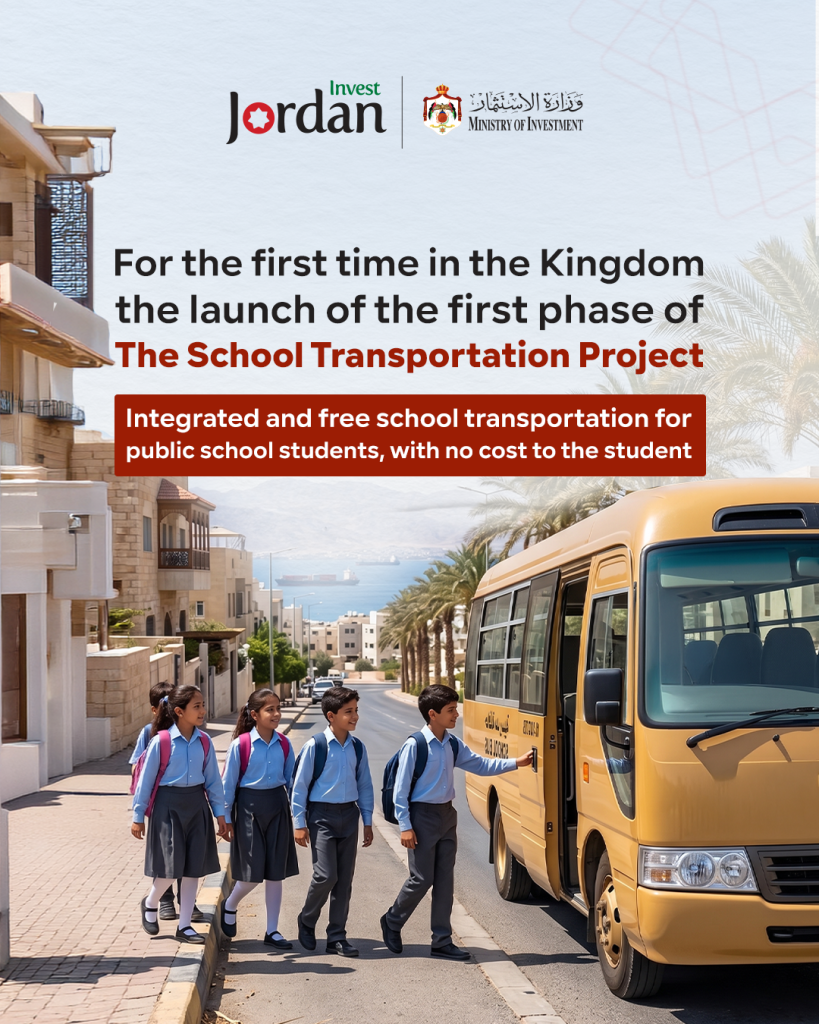
The Ministry of Education, in partnership with a consortium of local and international companies, signed on Tuesday in Ma’an Governorate the final operating agreement for the “Proof of Concept for School Transportation in the Southern Badia and Aqaba” project, marking the official commencement of implementation at the start of the upcoming academic year.
The agreement aims to regulate the contractual framework between both parties for the implementation of a government-led school transportation proof-of-concept project in partnership with the private sector. The initiative will serve public school students, teachers, and staff across the designated operational areas.
The agreement was signed on behalf of the Ministry of Education by Minister Azmi Mahafzah, and on behalf of the consortium by representatives of the participating companies implementing the project. The signing ceremony was attended by Minister of Investment Dr. Tareq Abu Ghazaleh, Ma’an Governor Khaled Al-Hajaj, and Secretary-General of the Ministry of Education for Administrative and Financial Affairs, Sahar Al-Shakhatreh.
This project comes as part of the government’s broader efforts to develop the school transportation system and provide a safe, reliable, and free transport service for students. It aims to ease the financial burden on families, improve student attendance, and support the overall education process, with plans for gradual expansion to cover all governorates across the Kingdom.
Speaking at the signing ceremony, Mahafzah stated that the project represents a qualitative step toward supporting the education sector and improving the learning environment. He emphasized that it reflects the government’s commitment to ensuring a safe and equitable educational environment for all students, while addressing one of the most pressing challenges facing families—school transportation—through sustainable solutions that guarantee safe and easy access to schools.
He added that the first phase of the project includes the operation of 156 modern buses serving 61 schools, benefiting approximately 9,000 students and nearly 900 administrative and teaching staff members. The project incorporates a comprehensive system of safety standards, specialized training programs for drivers and bus assistants, and buses equipped with the latest safety technologies, monitoring systems, and electronic tracking. It also includes a unified free mobile application that enables parents to track their children’s journeys.
For his part, Abu Ghazaleh highlighted that the free school transportation project represents a practical model of effective public-private partnership, reflecting the government’s direction toward attracting high-quality investments that directly contribute to improving service delivery for citizens.
He added that the project goes beyond providing safe and free transportation for students, as it also contributes to job creation and stimulates economic activity in the governorates, particularly in the Southern Badia. In its first phase, the project is expected to generate around 300 direct job opportunities. He noted that the initiative marks the beginning of a series of development projects the government intends to implement to promote balanced regional development.
Meanwhile, representatives of the participating consortium affirmed that the companies involved possess extensive experience in executing similar projects, having previously implemented comparable initiatives across several countries in the region.
They emphasized that the project will adhere to the highest technical and operational standards to ensure sustainability, efficiency, and service quality, noting that this public-private partnership stands as a successful model for delivering development projects with direct impact on citizens.