
Minister of Investment: New Amendments to the Investment Environment Framework Enhance Jordan’s Investment Competitiveness and Support Sustainable Development
– 313 new investor cards issued during the first quarter of 2026
– 92 new projects benefited from exemptions with investments totaling JOD 106 million
Amman – Minister of Investment Dr. Tareq Abu Ghazaleh affirmed that the government continues to advance the objectives of the Economic Modernization Vision by further developing the investment environment and positioning investment as a key driver of economic growth, sustainable development, and job creation.
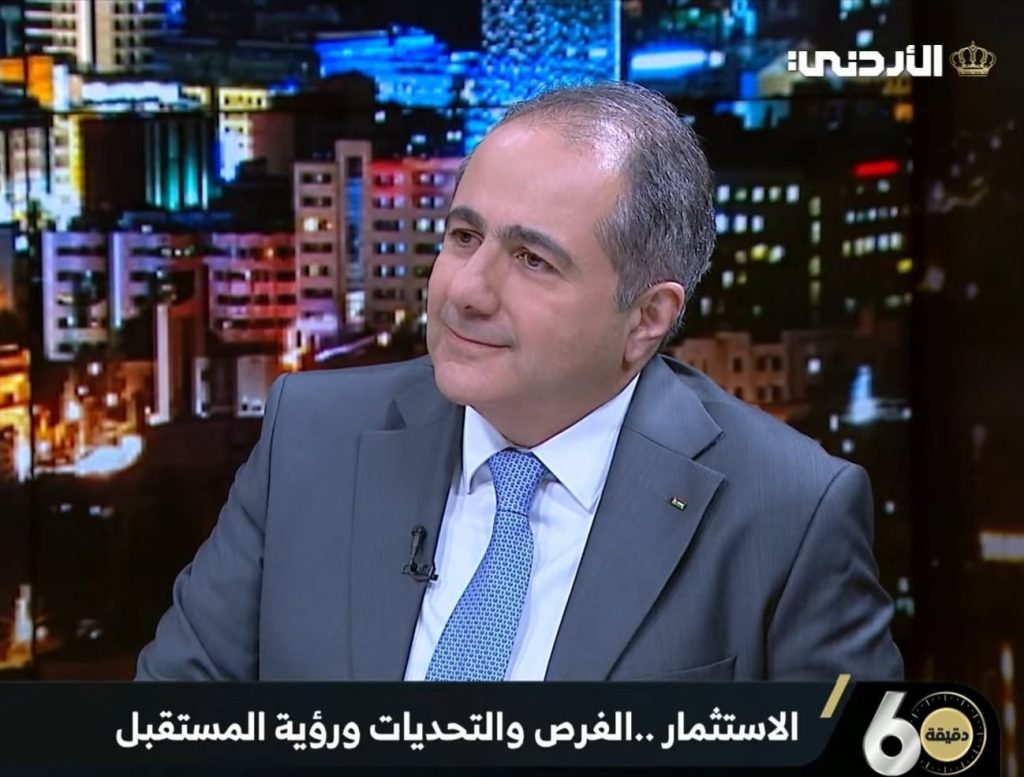
During his appearance on the Jordan Television program “60 Minutes,” Dr. Abu Ghazaleh stated that investment is no longer limited to attracting capital and foreign direct investment, but has become a strategic tool for improving citizens’ quality of life and promoting development across all regions of the Kingdom.
Dr. Abu Ghazaleh noted that the Ministry of Investment has recently implemented a package of legislative and regulatory measures aimed at improving the business environment and facilitating the investor journey, most notably the approval of the amended Investment Environment Regulation for 2026.
Speaking with journalist Anas Al-Majali, he explained that the amended regulation, recently approved by the Council of Ministers, was introduced in response to practical observations and stakeholder feedback following extensive consultations with a broad range of investors and public- and private-sector entities.
He emphasized that the amendments focus on simplifying procedures, reengineering a number of processes and services, and reducing both time and costs for investors, with the aim of accelerating project implementation and enhancing Jordan’s attractiveness for local and foreign investment.
The Minister added that the amended regulation expands investment incentives by reducing the expansion requirement for existing projects from 25% to 5%. It also includes creative industries among the sectors eligible for investment incentives and exemptions, supporting innovation and entrepreneurship while creating greater opportunities for young people to transform their ideas and skills into productive businesses.
He further explained that the amendments allow companies majority-owned by Jordanians abroad to register as Jordanian companies, with the objective of attracting Jordanian capital and encouraging expatriate Jordanian investors to expand their businesses within the Kingdom.
On another front, Dr. Abu Ghazaleh affirmed that Jordan continues to achieve positive investment indicators despite regional challenges, noting that foreign direct investment inflows increased by 25% during the previous year.
He pointed to the continued positive performance during the first quarter of 2026, with 92 projects benefiting from investment exemptions totaling JOD 106 million in investments. The Ministry also issued 313 new investor cards during the same period, reflecting sustained confidence in Jordan’s investment environment.
The Minister highlighted the Ministry’s ongoing coordination with other government entities, noting that a national investment map has been developed featuring nearly 100 investment opportunities distributed across the Kingdom’s governorates. The initiative aims to transform opportunities into bankable and implementable projects and promote them through digital platforms, Jordanian embassies, and diplomatic missions worldwide, in unprecedented coordination between the Ministry of Investment and the Ministry of Foreign Affairs and Expatriates.
Dr. Abu Ghazaleh stressed that real investment should not be measured solely by figures and indicators, but by its tangible impact on citizens’ lives through job creation, improved services, and sustainable development across the Kingdom.
He also pointed to the School Transportation Project, launched by the government in its first phase in the Southern Badia region, as a leading example of this development-oriented approach. The project not only provides safe transportation for students, but also represents an integrated development initiative that supports the education sector, creates employment opportunities, and improves the quality of life for families and students.
He added that the project provides modern buses equipped with the highest safety standards and advanced technologies, ensuring a safer and more stable educational environment while reflecting the government’s commitment to implementing sustainable development projects with a direct impact on citizens’ lives.