
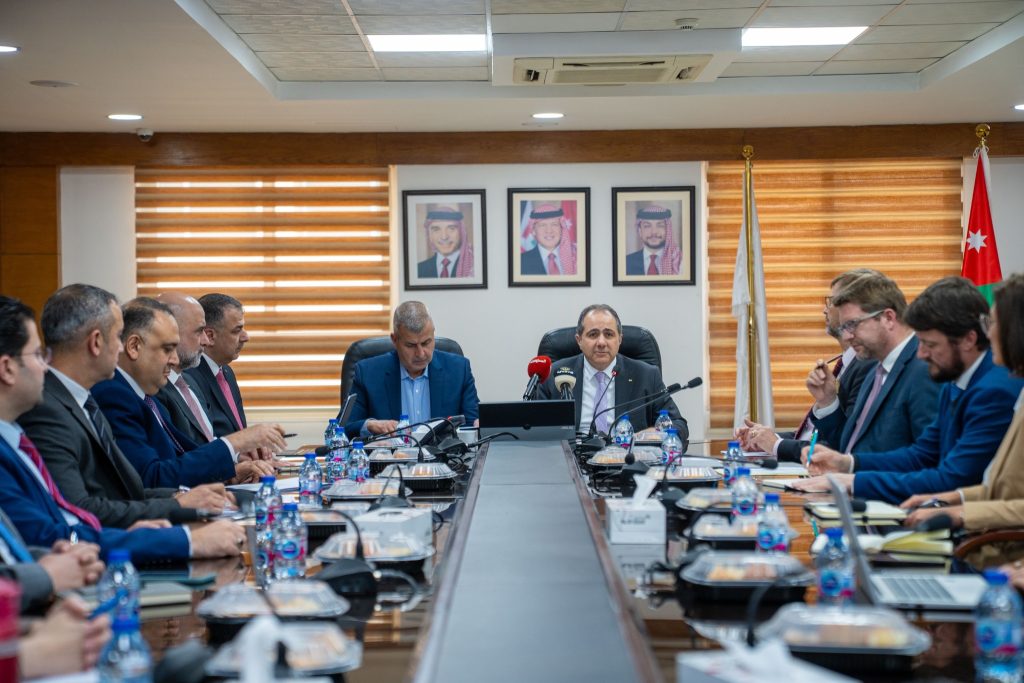
Amman — The Ministry of Investment on Monday hosted the kick-off meeting for the preparation of a feasibility study for a pumped-storage hydropower project in Wadi Al-Mujib, in the presence of Minister of Energy and Mineral Resources Dr. Saleh Al-Kharabsheh, Minister of Investment Dr. Tareq Abu Ghazaleh, and the Ambassador of the Federal Republic of Germany to Jordan Dr. Bertram von Moltke.
The project, the first of its kind in Jordan, aims to develop a closed-loop pumped-storage hydropower plant with a capacity of 450 megawatts, in a move set to enhance the flexibility, efficiency, and long-term sustainability of the Kingdom’s electricity system.
Participants reviewed the main components of the feasibility study, with the attendance of the Water and Energy Programme Coordinator at Deutsche Gesellschaft für Internationale Zusammenarbeit (GIZ), the Secretary-General of the Water Authority of Jordan, the Director General of the National Electric Power Company, and the Director of the Public-Private Partnership Unit at the Ministry of Investment, alongside representatives from the Ministry of Planning and International Cooperation and the Ministry of Finance.
During the opening session, Minister Abu Ghazaleh underscored that the project reflects the government’s commitment to implementing strategic initiatives that strengthen energy security and advance sustainability. He described the project as a leading model for public-private partnership and a clear indication of Jordan’s direction toward building a competitive and investor-friendly environment.
He added that the project aligns with the government’s executive program to enhance the investment climate through efficiency and sectoral diversification, emphasizing that cooperation with international partners—particularly Germany—remains a cornerstone for the success of such strategic projects and the achievement of sustainable development goals.
For his part, Minister Al-Kharabsheh highlighted that the Wadi Al-Mujib energy storage project represents a strategic infrastructure investment aimed at enhancing energy supply security while reducing costs, noting that it incorporates the latest global technologies and best practices.
He added that the project will contribute to improving energy management, boosting the reliability and efficiency of the power system, supporting the expansion of renewable energy generation, and diversifying energy sources, thereby ensuring long-term sustainability.
Meanwhile, Ambassador von Moltke stressed the importance of the project as a first step toward developing energy storage solutions in Jordan and as a key strategic initiative supporting the Kingdom’s energy security. He reaffirmed Germany’s commitment to continuing its support for Jordan in vital sectors linked to sustainable development, particularly energy and water, further strengthening bilateral cooperation.
The project is being developed under a public-private partnership framework, with a comprehensive feasibility study covering technical, legal, and financial aspects, paving the way for the launch of the project tender in the third quarter of 2026, in line with international best practices.
The project is supported by the German Federal Ministry for Economic Cooperation and Development and implemented in cooperation with Deutsche Gesellschaft für Internationale Zusammenarbeit (GIZ), as part of the ongoing partnership with Jordan to strengthen the governance of the water–energy–food–environment nexus.